
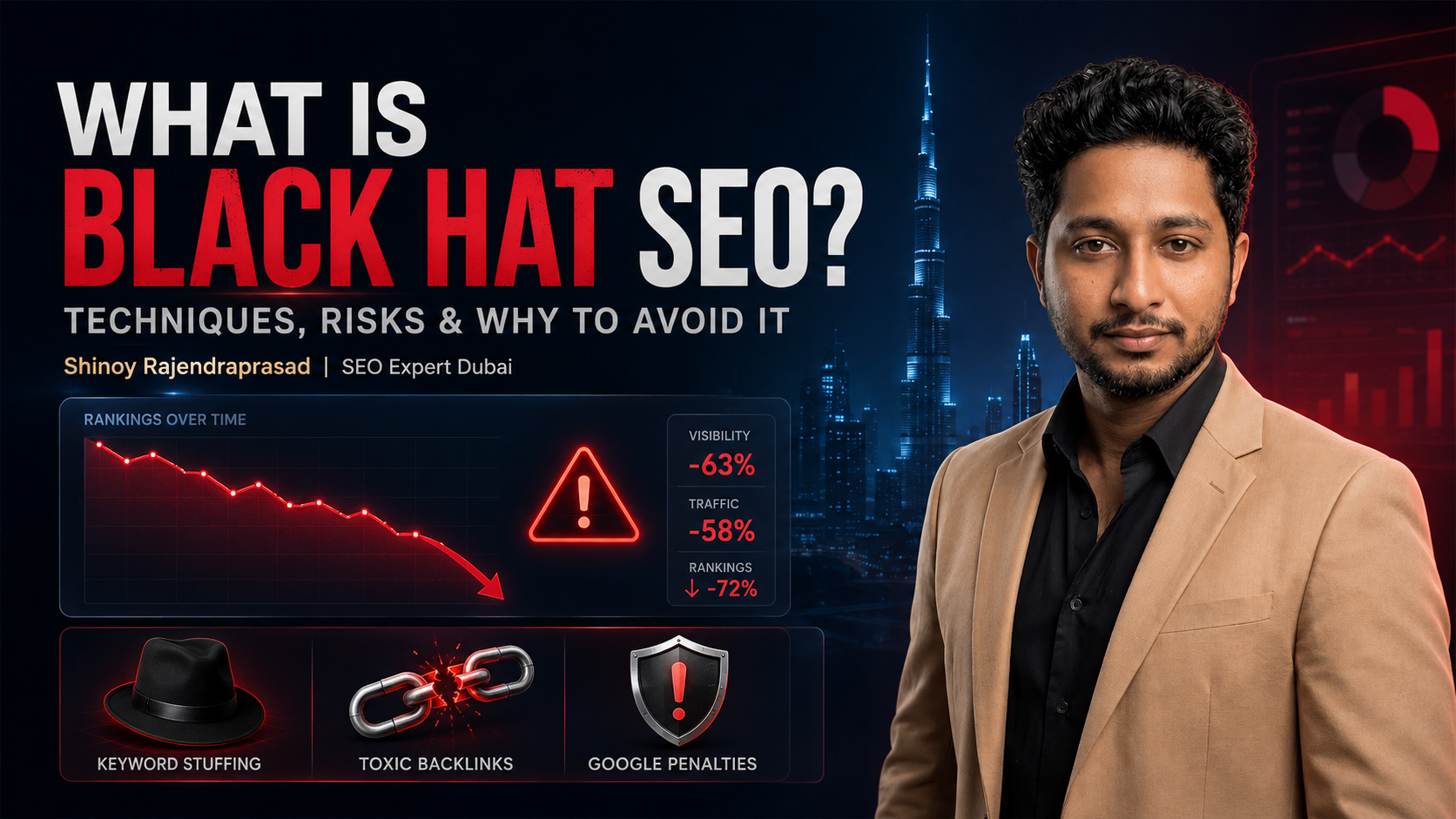
If you are wondering what is black hat SEO, it refers to search engine optimization practices that attempt to manipulate rankings through deceptive, misleading, or spam-based techniques.
These methods may appear attractive because they promise quick improvements in search visibility. However, they can damage your website’s reputation, reduce your rankings, and expose your business to penalties or removal from search results.
For businesses in Dubai and the UAE, sustainable online growth depends on ethical SEO strategies, useful content, strong website performance, and a positive user experience.
In this article, you will learn what black hat SEO is, how it differs from white hat SEO, which techniques to avoid, and how to protect your website.
What Is Black Hat SEO?
Black hat SEO describes techniques used to manipulate search engine rankings without providing genuine value to website visitors.
These practices usually conflict with Google’s spam policies for web search.
Examples include:
Repeating keywords unnaturally.
Buying backlinks specifically to manipulate rankings.
Publishing copied or low-value content.
Hiding keywords or links from website visitors.
Showing different content to search engines and human users.
Creating large numbers of pages only to target search terms.
Using misleading redirects or deceptive website practices.
Black hat SEO focuses on exploiting search systems rather than helping users find relevant, trustworthy information.
Although certain tactics may create temporary visibility, their long-term risks usually outweigh any short-term benefits.
What Is White Hat SEO?
White hat SEO refers to legitimate optimization practices that improve website visibility while following search engine guidelines and serving users.
Instead of attempting to manipulate rankings, white hat SEO focuses on producing useful content and improving the overall website experience.
Common white hat SEO practices include:
Writing original, informative articles.
Researching relevant search terms.
Using keywords naturally.
Improving website speed and mobile usability.
Creating clear page titles and meta descriptions.
Building useful internal links.
Earning genuine backlinks from relevant websites.
Making websites accessible and easy to navigate.
Updating outdated information.
Following Google Search Essentials.
A reliable SEO strategy is designed to support lasting visibility rather than temporary ranking improvements.
Businesses looking for sustainable online growth can explore professional SEO services in Dubai built around ethical optimization.
Black Hat SEO vs. White Hat SEO
The main difference between black hat SEO and white hat SEO is the purpose behind the strategy.
Black hat SEO attempts to manipulate search rankings, often without considering whether the content helps users.
White hat SEO aims to improve search visibility by creating genuinely useful content and a better website experience.
For example, a black hat strategy might repeat the phrase “SEO expert Dubai” dozens of times in one paragraph.
A white hat strategy would explain how an SEO expert helps businesses improve website performance, attract relevant visitors, and generate inquiries while using the phrase naturally.
Another example is backlink building.
Black hat SEO may involve purchasing hundreds of links from irrelevant websites.
White hat SEO focuses on earning links through original content, useful resources, professional relationships, and relevant industry coverage.
Common Black Hat SEO Techniques
Black hat SEO can take many forms. Understanding these practices helps businesses avoid harmful strategies and choose trustworthy marketing partners.
1. Keyword Stuffing
Keyword stuffing happens when a website repeats the same words or phrases unnaturally to influence search rankings.
For example:
Our SEO expert Dubai provides SEO expert Dubai services for businesses looking for the best SEO expert Dubai and professional SEO expert Dubai support.
This sentence repeats the same keyword without adding useful information.
A clearer version would be:
Our Dubai SEO services help businesses improve search visibility, attract relevant website visitors, and generate qualified inquiries.
Keywords should support the meaning of your content. They should not make your writing difficult to read.
Google identifies keyword stuffing as a spam practice when terms are used excessively or out of context. Google’s spam policies
2. Low-Quality or Unhelpful Content
Low-quality content usually offers little original information or value to the reader.
Examples include:
Articles copied from other websites.
Pages rewritten without adding useful insights.
Content that does not answer the user’s question.
Repetitive pages targeting slightly different keywords.
Articles created only to attract search traffic.
Pages containing misleading or inaccurate information.
Good SEO content should clearly answer a question, explain a topic, or help users make informed decisions.
For example, an article about choosing an SEO specialist in Dubai should provide practical guidance rather than repeat promotional phrases.
Businesses should prioritize original information, clear explanations, accurate examples, and relevant professional experience.
3. Buying Backlinks to Manipulate Rankings
Backlinks are links from other websites to your website.
They can help search engines discover content and understand connections between websites. However, buying or selling links specifically to manipulate rankings can violate Google’s spam policies.
Examples include:
Purchasing large backlink packages.
Paying unrelated websites to publish links that pass ranking value.
Joining networks that exist primarily to exchange links.
Using automated software to generate links.
Publishing paid articles solely to manipulate search visibility.
However, paid advertising and sponsorship are not automatically prohibited.
Google explains that advertising or sponsored links can be acceptable when properly identified using attributes such as:
rel="sponsored"or:
rel="nofollow"The issue is not simply that money was involved. The problem occurs when paid links are used to manipulate search rankings without appropriate disclosure. Google’s guidance on link spam
4. Hidden Text and Hidden Links
Hidden text involves placing content on a webpage where search engines might detect it, but ordinary visitors cannot easily see it.
Examples include:
Using white text on a white background.
Hiding text behind images.
Setting text size to zero.
Positioning content outside the visible screen.
Placing hidden links inside punctuation marks.
These practices are deceptive when their purpose is to manipulate search rankings.
However, normal website features such as expandable sections, tabs, and accessibility tools are not automatically violations. The distinction depends on whether the content improves the user experience or intentionally misleads search engines.
5. Cloaking
Cloaking means showing one version of a page to search engines and a different version to website visitors with the intention of manipulating rankings.
For example, a search engine may see an informative article about digital marketing, while visitors are redirected to an unrelated sales page.
This creates a mismatch between what users expect and what they actually receive.
Google considers deceptive cloaking a violation of its spam policies. Google’s explanation of cloaking
6. Doorway Pages
Doorway pages are created primarily to rank for multiple similar searches while providing little unique value.
For example, a business might publish dozens of almost identical pages such as:
SEO expert Dubai Marina.
SEO expert Downtown Dubai.
SEO expert Business Bay.
SEO expert Jumeirah.
SEO expert Deira.
If every page contains nearly identical text and sends visitors to the same destination without providing useful local information, these pages may be considered doorway pages.
Location pages can be legitimate when they offer unique, relevant information and accurately describe services available in each area.
The key is whether the page genuinely helps the visitor.
7. Scraped or Copied Content
Scraping involves copying content from other websites and republishing it without adding meaningful original value.
Examples include:
Copying complete articles from another website.
Automatically collecting content from multiple sources.
Replacing a few words in someone else’s article.
Republishing product descriptions without additional information.
Combining copied paragraphs from different websites.
Publishing duplicate information does not automatically mean a website will receive a penalty. However, copying content specifically to manipulate search rankings without providing original value can violate Google’s spam policies.
A stronger approach is to write original articles based on your knowledge, experience, and understanding of your audience.
8. Scaled Content Abuse
Scaled content abuse happens when a website produces large numbers of pages primarily to manipulate search rankings rather than help users.
For example, a business might publish hundreds of nearly identical articles targeting different cities or keywords without providing useful local information.
This can happen with automated tools, content templates, or generative AI.
However, AI-generated content is not automatically against Google’s rules. The concern is whether the content provides genuine value or exists mainly to manipulate rankings.
A useful AI-assisted article can be acceptable when reviewed carefully, corrected for accuracy, and improved with original insights.
Publishing large volumes of unhelpful content without meaningful review can create SEO problems. Google’s policy on scaled content abuse
9. Sneaky Redirects
A redirect sends visitors from one URL to another.
Redirects are often legitimate. For example, a 301 redirect is useful when a business changes a webpage address or moves to a new domain.
However, redirects become problematic when they deceive users or search engines.
Examples include:
Showing one page to Google but redirecting users somewhere unrelated.
Sending mobile visitors to unexpected promotional websites.
Redirecting users to misleading or harmful pages.
Using a trusted page to attract visitors and then sending them to unrelated content.
Redirects should help users reach the correct destination, not mislead them.
10. Private Blog Networks
A private blog network is a collection of websites used to create backlinks to another website.
Not every group of related websites is automatically problematic. However, a network created mainly to manipulate search rankings through artificial links can fall under Google’s link spam policies.
Warning signs include:
Unrelated websites linking to the same business.
Websites with little useful content.
Repeated use of identical keyword-rich links.
Domains created primarily to sell backlinks.
Large numbers of links appearing suddenly without a clear reason.
A better strategy is to earn links from relevant websites through useful content, genuine partnerships, and professional recognition.
Why Black Hat SEO Is Dangerous
Black hat SEO can create serious problems for businesses that depend on online visibility.
Lower Search Rankings
Google may identify manipulative practices through automated systems or human review.
When a website violates spam policies, affected pages may rank lower or disappear from search results.
A temporary ranking increase is not valuable if it is followed by a significant loss of visibility.
Manual Actions
Google may issue a manual action when a human reviewer determines that a website does not follow its spam policies.
Website owners can check for manual actions in Google Search Console.
If a manual action is issued, the website owner generally needs to identify the problem, correct the affected content or links, and request a review.
Google provides further guidance in its Manual Actions report documentation.
Reduced Website Traffic
A drop in rankings can lead to fewer visitors, inquiries, and sales.
For businesses that rely on search visibility, this can affect marketing performance and revenue.
A professional website should attract relevant visitors who are genuinely interested in its products or services.
Damage to Brand Reputation
Deceptive or low-quality SEO practices can make a business appear unreliable.
Visitors may lose confidence if they encounter misleading pages, copied content, irrelevant links, or unrealistic claims.
A strong online reputation depends on clear communication, accurate information, and a consistent user experience.
Expensive Recovery
Recovering from harmful SEO practices may require:
Removing or correcting low-quality content.
Reviewing artificial or paid backlinks.
Fixing misleading redirects.
Improving website security.
Rebuilding useful pages.
Requesting a review after a manual action.
Restoring customer trust.
Recovery can take time, and improvements are not guaranteed immediately.
How to Identify an Untrustworthy SEO Provider
Be careful if an SEO company promises:
Guaranteed first position on Google.
Thousands of backlinks within a few days.
Immediate results without reviewing your website.
Unlimited articles with no quality control.
Secret methods that cannot be explained.
Rankings for every keyword regardless of competition.
Large volumes of traffic without clear reporting.
Paid links presented as guaranteed ranking improvements.
No SEO professional can honestly guarantee a specific Google ranking.
A trustworthy provider should explain the strategy, discuss realistic expectations, provide transparent reporting, and focus on long-term improvements.
How to Build an Ethical SEO Strategy
An effective white hat SEO strategy focuses on helping users and improving website quality.
Publish Useful, Original Content
Create content that answers genuine questions from your audience.
For example, a Dubai business could publish articles about local customer needs, industry developments, product comparisons, and service-related questions.
Your content should be clear, accurate, and relevant to the people you want to reach.
Use Keywords Naturally
Research the terms your audience searches for, then use them naturally in:
Page titles.
Main headings.
Meta descriptions.
Relevant subheadings.
Image alt text.
Internal links.
The body of your article.
Avoid repeating the same phrase so often that the content becomes unnatural.
Improve Website Performance
A well-structured website should be easy to use across different devices.
Focus on:
Mobile-friendly design.
Clear navigation.
Fast-loading pages.
Secure connections.
Accessible content.
Working links.
Accurate contact information.
Website improvements should help visitors complete their goals, whether they want to read an article, purchase a product, or contact your business.
Earn Relevant Backlinks
Quality backlinks usually come from useful content and genuine relationships.
Examples include:
Industry publications.
Professional collaborations.
Relevant business directories.
Original research.
Expert interviews.
Local partnerships.
Valuable resources that others choose to reference.
The goal is to earn visibility through relevance and credibility rather than artificial link schemes.
Create Strong Internal Links
Internal links help visitors discover related pages on your website.
For example, if you are reading about ethical SEO practices, you may also want to explore professional SEO services or learn more about digital marketing services in Dubai.
Relevant internal links can improve website navigation and help search engines understand your site structure.
Monitor Google Search Console
Google Search Console helps website owners review indexing, search performance, and potential technical issues.
Use it to:
Check whether your pages appear in Google Search.
Inspect individual URLs.
Review indexing problems.
Monitor clicks and impressions.
Identify manual actions.
Submit your XML sitemap.
Request indexing after updating important pages.
After improving an existing article, you can submit the updated URL through the URL Inspection tool and request indexing. Google’s recrawling guidance
Why Ethical SEO Matters for Businesses in Dubai
Dubai is a competitive market where businesses depend on trust, visibility, and a strong online reputation.
Customers often compare multiple companies before choosing a service provider. A website that offers clear information, useful content, and a professional user experience is better positioned to earn their confidence.
Unethical SEO may create temporary visibility, but it can damage your reputation and put your search performance at risk.
An ethical SEO strategy supports more sustainable business growth by focusing on relevant search traffic, customer needs, and transparent marketing practices.
If you are searching for professional guidance, learn more about Shinoy Rajendraprasad, SEO Expert Dubai.
Frequently Asked Questions
What is black hat SEO?
Black hat SEO refers to manipulative optimization practices that attempt to improve search rankings through methods that violate search engine spam policies.
Is black hat SEO illegal?
Black hat SEO is not automatically illegal, but it may violate search engine policies. Certain activities, such as hacking, fraud, or unauthorized access, may also involve legal violations depending on the circumstances.
Can black hat SEO improve rankings?
Some manipulative tactics may create temporary visibility. However, they can also lead to lower rankings, manual actions, or removal from search results.
Is buying backlinks always against Google’s rules?
No. Paid advertising and sponsorship links can be acceptable when properly identified with attributes such as rel="sponsored" or rel="nofollow". Buying links specifically to manipulate rankings is the problem.
Is AI-generated content considered black hat SEO?
No. AI-assisted content is not automatically prohibited. Problems arise when large amounts of unhelpful content are produced mainly to manipulate rankings.
What is the difference between black hat SEO and white hat SEO?
Black hat SEO attempts to manipulate search engines through deceptive practices. White hat SEO improves visibility by creating useful content, improving website quality, and following search engine guidelines.
How can I check whether my website has a Google penalty?
Open Google Search Console and review the Manual actions section. If Google has issued a manual action, follow the instructions to correct the problem and request a review.
How can I improve my website rankings safely?
Focus on original content, relevant keywords, clear website structure, useful internal links, reliable technical performance, and genuine backlinks.
Final Thoughts
Understanding what is black hat SEO can help you avoid strategies that damage your website’s visibility and reputation.
Practices such as keyword stuffing, manipulative paid links, hidden text, cloaking, and low-value content may appear to offer quick results, but they can create long-term problems.
A successful SEO strategy should focus on useful content, ethical optimization, and an improved user experience.
If you need professional support, explore my SEO services, learn about my digital marketing services, or contact me to discuss your website’s growth.